


If you run a small bio-business in Latin America and need USD 30,000, the map of impact capital gets very small, very fast. I see it every week, and this year we finally put a number on it.
At Fondo de Impacto we help companies access impact capital, and part of that work is a database of capital sources for impact businesses in the region: funds, banks, credit unions, municipal savings banks, public programs and foundations. As of 28 October 2026 it holds 456 sources, all built from public information.
What the chart shows
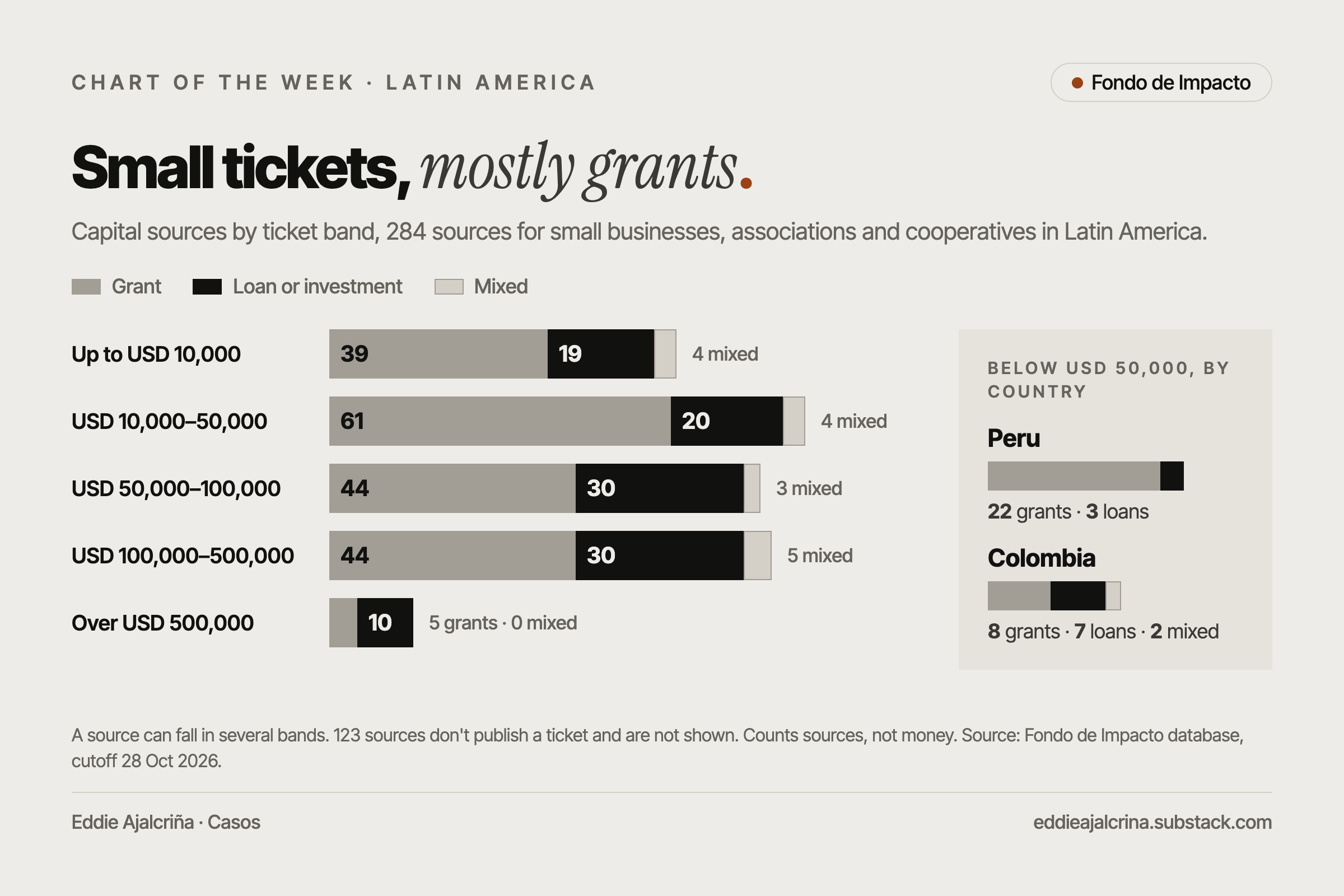
We filtered the 284 sources that serve micro, small and medium enterprises, associations and cooperatives in agriculture and the bioeconomy. Of those 284, 161 publish or estimate their ticket size, and of those, 108 reach tickets below USD 50,000: 77 offer grants and only 25 offer loans or investment. The balance only tips toward lending above USD 500,000, where 10 of the 15 sources lend.
A word on terms for readers outside the region. What we call «no reembolsable» covers grants, innovation competitions and matching funds from public programs and cooperation agencies, money that is not paid back. «Reembolsable» is credit, and occasionally equity.
How to read it, and how not to
This is our database, so I read it with care. It counts sources, not dollars: a public program that disburses millions counts the same as a small foundation. A source can fall in more than one ticket band. And 123 of the 284 sources don't publish a ticket at all, so they don't appear in the chart. It tells you where a small company is likely to find a door, not how much money goes through it.
The pattern also changes by country. In Peru, among the sources in our base that go below USD 50,000, 22 are grants and 3 are credit, among them a public agricultural development bank and the Biocrédito offered by municipal savings banks. In Colombia the count is closer, 8 and 7, with microfinance lenders. In Ecuador and Bolivia, public banks, credit unions and microfinance banks show up.
Why the order matters
Many people read this as good news: there is money to get started. I read it as a missing step. A small company moves from competition to competition, and when it finally needs a loan it arrives with no credit history, no collateral and no record of ever having repaid anything. The grant solved this year and left the next one where it was.
It is the other side of something I keep saying to networks and business associations: there is capital, and what is missing is fundable companies, with borrowing capacity, guarantees, a commercial structure and a team that can put together the technical proposal. A grant that never asks for any of that keeps the company outside the door it will need next.
If you fund small businesses in Latin America, what would it take for your grant to be the first step toward a loan?
Recommend this to someone who designs grant programs or small-ticket lending in the region.
Sources
Fondo de Impacto, database of capital sources for impact businesses in Latin America, cutoff 28 October 2026: 456 public sources; 284 filtered by beneficiary type (micro, small and medium enterprises, associations, cooperatives) and industry. Ticket bands come from the ranges each source publishes; one source can appear in several bands.