


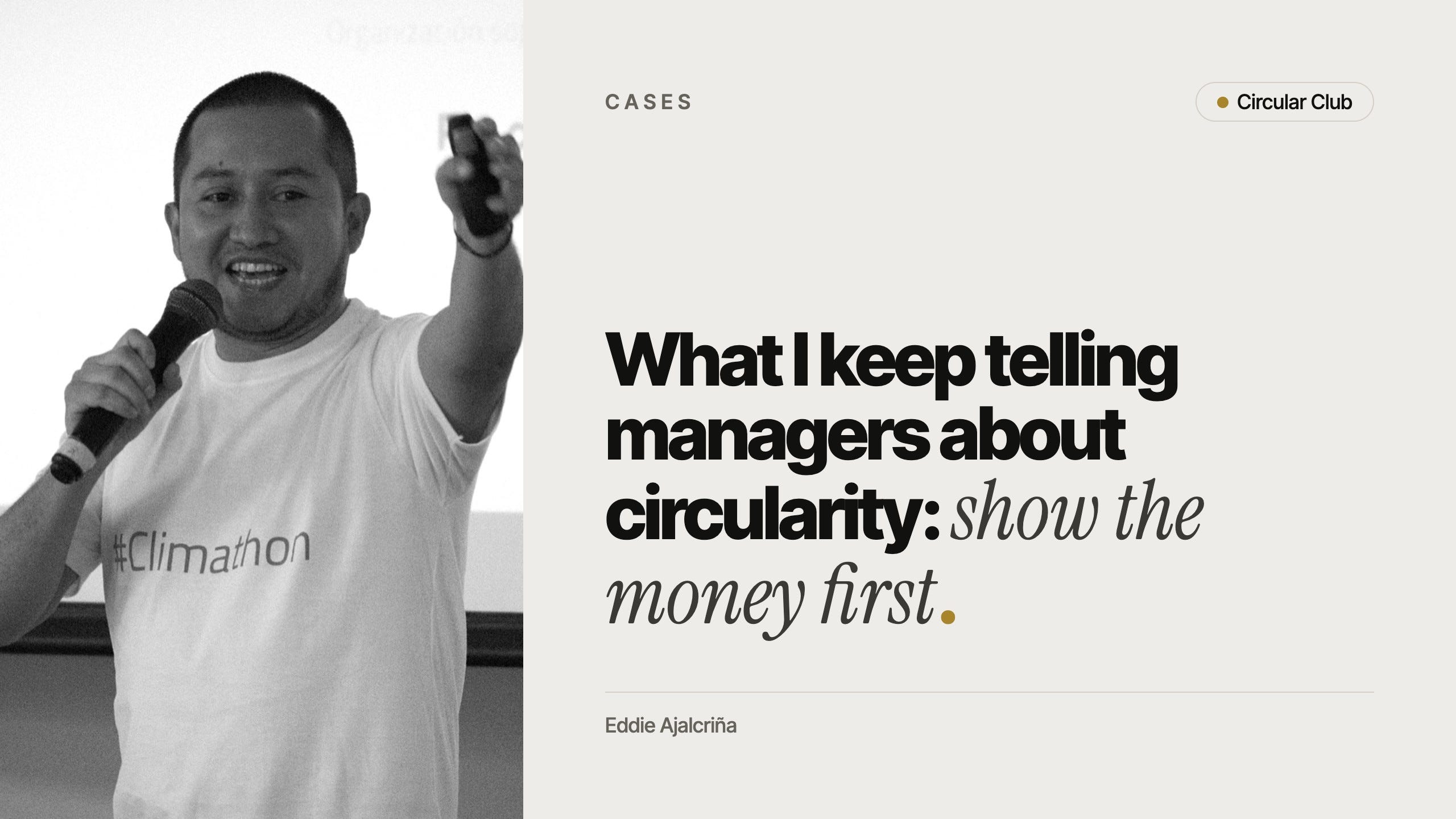
Since 2022 I have taught circular economy in MIT Professional Education programs, in Spanish, for executives across Latin America. The idea I end up repeating most is easy to say and hard to apply: a circular initiative lasts when it saves or earns money for whoever implements it.
Why the numbers come first
Show the economic impact first, and let the environmental and social gains come on top. Without numbers, circularity gets filed as corporate social responsibility, and that is usually the first line cut in the next budget review.
The number that convinces a finance team is often already inside the company. There is what a material allows you to recover, and there is what you actually recover today. The difference is money that leaves through the back door, and translated into dollars it is the best argument you can bring to a general manager.
It also matters who the number is for. A health fund is convinced by health costs avoided; a plant manager, by a saving that shows up next quarter. The same circular measure can be pitched three ways, and only one of them will land with the person who signs.
A paradox from the first week of class
In this year's orientation session I had a conversation with a participant that left me with a paradox: the companies that talk most about circular economy tend to report the fewest economic numbers, and many of the ones that make money with circular models, such as renting or offering a service, don't even call themselves circular.
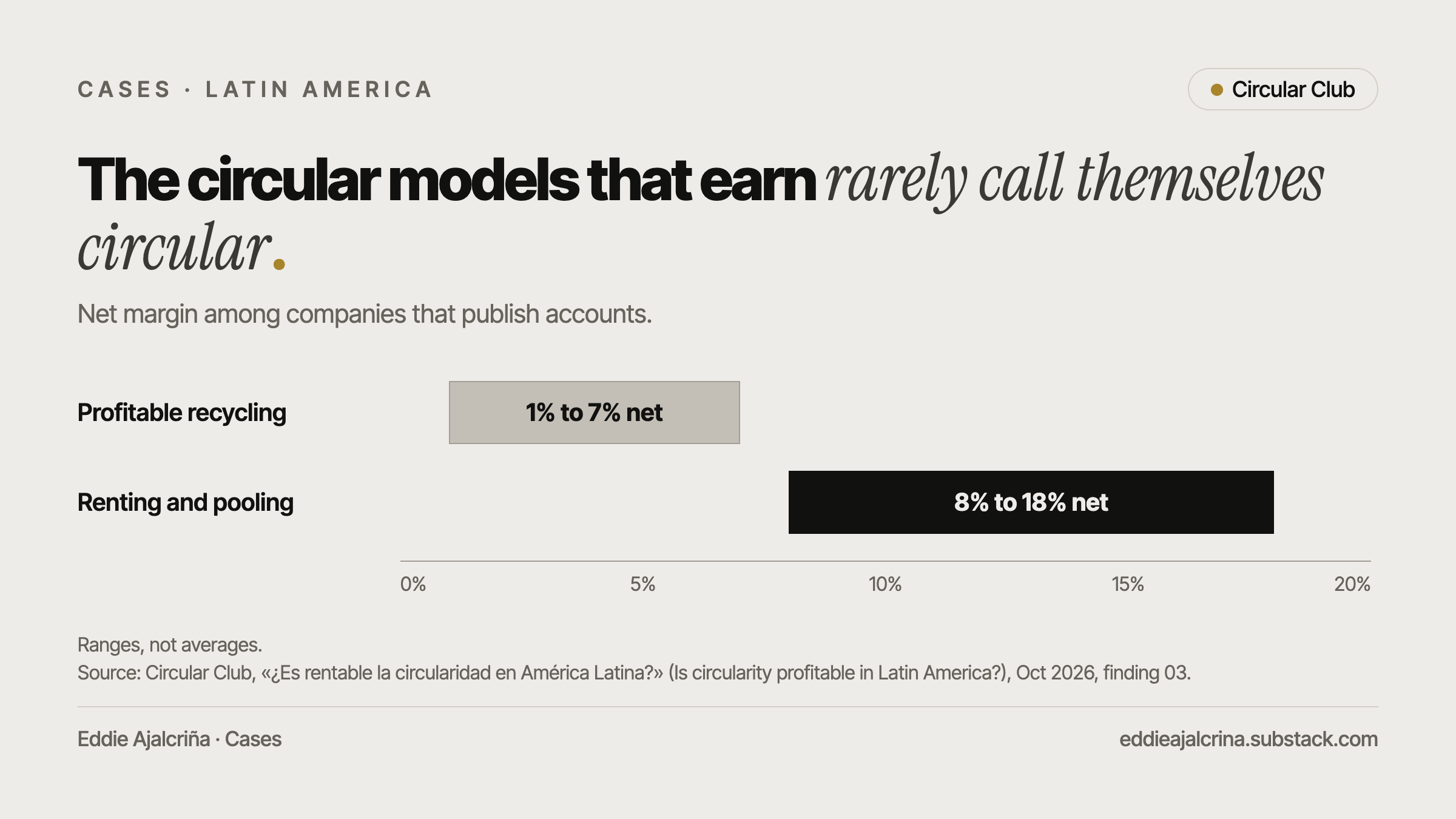
Our study at Circular Club, «¿Es rentable la circularidad en América Latina?» (Is circularity profitable in Latin America?), published in October, points the same way. Across 132 public cases from four databases, 87 corporate reports and 58 award-winning companies, none reports a margin or a realized return. Among companies that do publish accounts, profitable recycling nets between 1% and 7%, while renting and pooling, which are rarely presented as circular, net between 8% and 18%. In Latin America, the businesses that make money tend to be the ones that charge for the use of an asset, such as pallets, equipment or machinery, or steel mills that run on scrap, although none of them reports its circular line separately.
The same study found that companies' circular targets for 2025 were met only in part, and several stopped being published once they expired. The ones that held up were tied to a bond, to money. Where there is a financial consequence, the target gets looked after.
Measure against doing nothing
That is why we evaluate each circular measure against the option of doing nothing, with its own net present value, instead of defending circularity in the abstract.
Many of the companies I work with are large or mid-sized, and even there every circular investment competes with the operation itself. For readers outside the region, two things make the math harder here. Landfill is cheap: disposing of a ton costs between USD 7 and 14, while in Belgium or the UK the tax alone is over USD 100, so the savings that justify many European projects are thin in Latin America. And capital is expensive and short for smaller firms, which pushes the payback of any new equipment further out.
Scale changes the answer too. A technique that works for 200 kilos on a farm can stop being economic at four tons, and the response is to engineer it for that scale, not to drop it.
Three ways into the business
I sort circular measures by the level at which they enter the business: reducing risk, generating savings or generating new revenue. Almost everyone wants to start with the third, because a new product made from waste is what excites a room. New revenue comes more easily once the operation is in order. I'm writing about the three levels in Spanish tomorrow.
One measure that outlived its project
The cases that stay with me are modest. In one coffee business, part of the harvest was not being used and cost money to dispose of. With seed capital and technical assistance it became an infusion. When the project ended, the entrepreneur kept going, because from the start it was a good business and not a deliverable. Nobody had to convince him to continue.
What I would do on Monday
If I were running circularity inside a company in the region, I would:
List every circular measure under discussion and give each one a number against doing nothing, even a rough one.
Start with the measure that has an owner and a line in the budget, usually a cost you already pay.
Write the economic case for the person who funds it, in their units, before writing the environmental one.
On 24 November I'll publish a chart with how many of the 15 cases we modeled create value with the company's own capital.
If you teach circular economy, what number do your students struggle most to find inside their own companies?
If you run a program, a course or an event on circular economy or the bioeconomy and want a Latin American perspective with numbers, I'd be glad to talk about a guest lecture or a session.
Recommend this to someone who has to defend a circular project in front of a finance team.
Sources
MIT Professional Education, circular economy programs in Spanish (Eddie teaches since 2022).
Circular Club, «¿Es rentable la circularidad en América Latina?» (Is circularity profitable in Latin America?), published 16 October 2026, cutoff 2 October 2026: findings 01, 03, 04 and 05.