


On Tuesday I shared a chart from our capital database at Fondo de Impacto: below USD 50,000, 77 of the 108 sources that reach that band offer grants. For a small bio-business in Latin America, a grant is often the only door that opens. So the useful question is what a grant leaves behind when it ends.
I have been asking that for a while, from both sides of the table. This year I took part in the evaluation of 25 Amazonian bio-businesses for an acceleration program, and on 2 November I posted a short carousel on LinkedIn about three design decisions I keep seeing. This is the longer version.
What a grant is designed to pay for
For readers outside the region: grants for bio-businesses usually come from public programs, innovation funds and cooperation agencies. They are designed to pay for an asset or an innovation, a dryer, a small plant, a new product, a certification. And they are usually measured by what was disbursed and delivered.
What a small bio-business most often lacks is something else: cash during the harvest and someone who sells. So the grant gets pulled toward the gap. The most common request I heard this year was to use an innovation grant to buy raw material, and I understand it. But when the grant pays for this month's fruit, the problem that made it necessary is still there when the grant runs out, and the business arrives at the next season with the same hole and one less source of money.
There is a more visible version of the same problem. In October I wrote, in Spanish, about what I call white elephants: processing plants financed with grants, with equipment that doesn't fit the product or the volume, that barely operate. A plant like that can cost more than 3 million Peruvian soles, about USD 870,000, and it loses value every month it stands still, even if nobody counts that loss. The grant delivered the plant. Nobody was responsible for the business that had to fill it.
Three decisions made before the first grant
Part of this depends on the environment, expensive credit, few distributors. Another part is decided when the business is designed, long before the first grant arrives.
The first is selling before building. Start with the buyer, what specification they ask for, in what presentation and at what price, and only then size the plant. My own rule of thumb, not a norm: if the price per kilo isn't at least three times the freight per kilo, the business is shipping water. With illustrative numbers, 1,000 kilos of fresh fruit at 85% moisture, dried to 12%, become about 170 kilos.
The second is designing the harvest cash. Producers are paid in cash during a few months; buyers pay at 30, 60 or 90 days. If nobody plans that curve, the next grant fills it. Next Saturday I'll walk through a modeled camu camu business month by month, because the numbers are clearer than any description.
The third is not depending on one person or a handshake. Rules on price, quality and payment that nobody wrote down hold while volumes are small, and stretch when a large buyer arrives.
Grants for the asset, loans for the cycle
In the Bio Business Playbook we propose financing a bio-business in tranches: the founders' own capital to validate, grants for the asset and a loan for the production cycle, once you know how much you sell and when you get paid. Each type of money goes to the part of the business it fits.
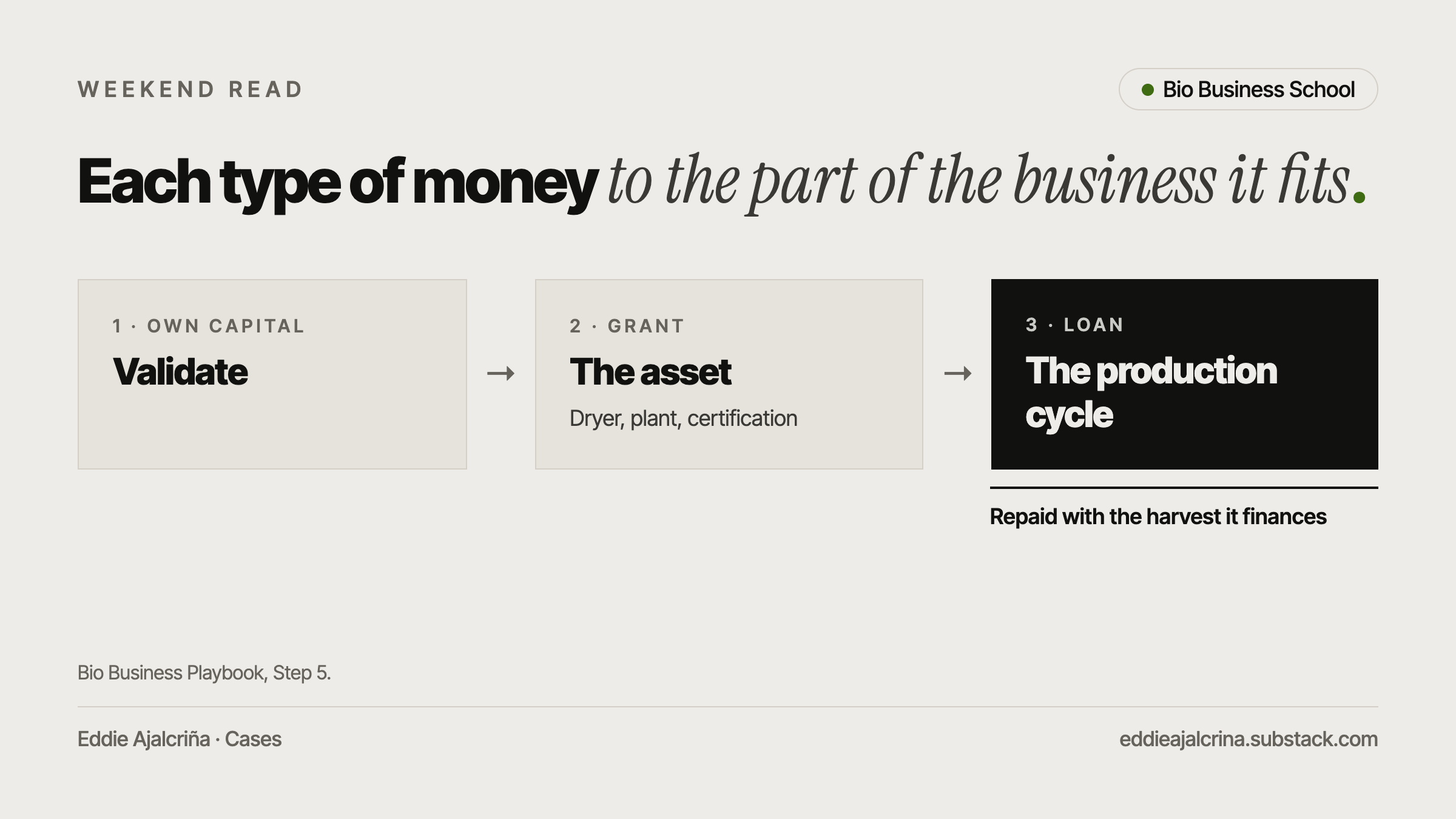
That is also where the grant can become the first step toward a loan, as I argued on Tuesday. A grant that pays the dryer and asks the company to keep clean accounts and a real sales record leaves it ready to borrow for the harvest.
If you run or evaluate a grant program for small businesses, what do you check two years after the last payment?
If you work with Latin American bio-businesses as a fund, a program or a university, I'd be glad to compare notes or bring these cases to your class or event.
Recommend this to someone who designs or evaluates grant programs in emerging markets.
Sources
Fondo de Impacto, database of capital sources for impact businesses in Latin America, cutoff 28 October 2026.
Bio Business School, Bio Business Playbook (November 2026), Step 5: harvest cash and three capital paths.
Eddie Ajalcriña, «Why so many bio-businesses stall after the grant», LinkedIn carousel, 2 November 2026.